How-to
Export tickets to CSV
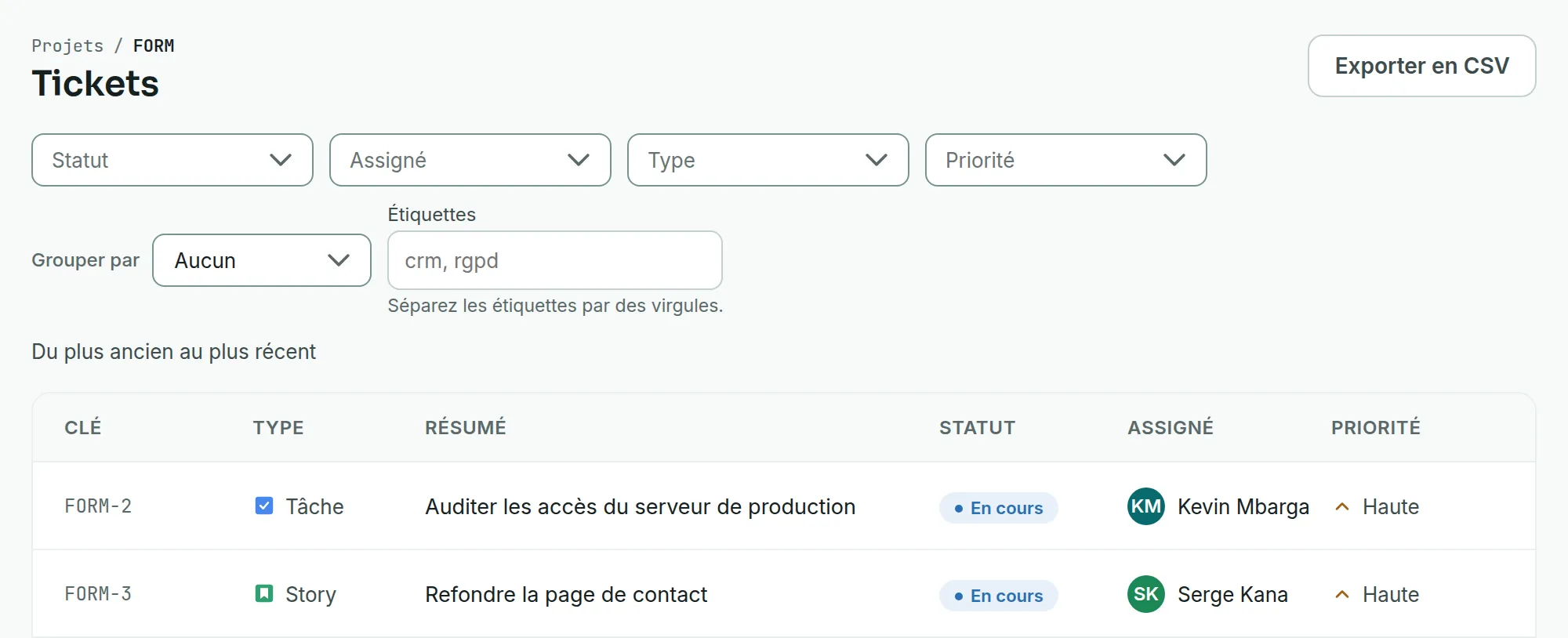
The Export to CSV button downloads every ticket that meets your criteria, including those the page does not show yet. It is available in advanced search and in a project’s Tickets, Backlog and Board screens.
Export from advanced search
Link to the “Export from advanced search” section- Open advanced search from the Filters tab in the top bar.
- Set at least one criterion. The Export to CSV button appears in the results header.
- Click Export to CSV. While the file is being prepared, the button shows Exporting….
- The file downloads, and a message gives its name, for example “12 tickets exported to FORM-recherche-2026-10-01.csv”.
Export from a project
Link to the “Export from a project” section- In your project, open Issues, Backlog or Board in the sidebar. Issues opens the Tickets screen.
- Set the screen’s filters if you want to narrow the list.
- Click Export to CSV. In the backlog, the button is in the header of the backlog list.
Each screen exports its own list:
| Screen | What the file contains |
|---|---|
| Tickets | The project’s tickets that meet the Status, Assignee, Type, Priority and Labels filters. |
| Backlog | The backlog tickets that meet its filters, without those in sprints. |
| Board | The tickets the board shows with its filters, which means those of the current sprint when there is one. |
Open the file
Link to the “Open the file” section- Open the downloaded file in your spreadsheet.
- If all the values sit in a single column, import the file again, choosing the comma as separator and UTF-8 as encoding.
The file has a header row, then one row per ticket, in sixteen columns: Key, Type, Summary, Description, Status, Priority, Labels, Assignee, Reporter, Created, Updated, Due date, Estimate, Sprint, Parent and Resolved. People, statuses and sprints are written by their name.
If you get stuck
Link to the “If you get stuck” section| What you see | What to do |
|---|---|
| “The export stops at 10000 rows, this product’s ceiling: the list holds more. Narrow the filters, then export again to get the rest.” | The file has arrived, but it is incomplete. Export in several goes, for example project by project or by creation period. |
| “The CSV export failed.” | Click Retry in the message. |
| The Export to CSV button does not appear in advanced search. | No criterion is set. Set at least one. |
| All the values are in the first column. | The file’s separator is the comma. Tell your spreadsheet when you open the file. |
| The Parent column holds a long identifier instead of a key. | The ticket’s parent is not in the file, because your criteria left it out. Widen the criteria to bring it in. |
Good to know
Link to the “Good to know” section- The file name combines the project key, the list and the day: FORM-tickets-2026-10-01.csv, FORM-backlog-2026-10-01.csv, FORM-tableau-2026-10-01.csv. A search across several projects gives projet-recherche-2026-10-01.csv. These names are the same in every language.
- Two exports of the same list on the same day have the same name.
- The creation, update and resolution dates use your computer’s time, in YYYY-MM-DD HH:MM format. The due date is in YYYY-MM-DD format.
- A ticket’s labels are separated by a semicolon within their cell. The description is plain text, without formatting.
- A file exported from an empty list only contains the header row.
Loading search…